I Went Hunting for the “Best” Brain Peptide. The One Everyone Hypes Turned Out to Be the Weakest

I’ll be straight with you: I went into this planning to write up dihexa as the winner. Every nootropic forum treats it like scripture, “the synaptogenesis miracle,” strongest thing on the market, orders of magnitude beyond anything else in the peptide aisle. So I read the actual papers behind that reputation, expecting to confirm it. Instead I found a compound whose foundational research has a formal warning stamped on it, and a companion drug built on the same mechanism that just face-planted in a real clinical trial. Meanwhile the peptide nobody talks about at parties turned out to be carrying the whole evidence base on its back.
This is my honest read after actually reading the studies instead of the sales copy. Quick disclosure before I start throwing punches: I’m not a doctor, I’m a skeptic with a library card. This is one reviewer’s dig through the literature to figure out which of these three peptides has anything real behind it. None of them is FDA-approved as a nootropic, full stop. And there’s one recent development that changes the whole conversation, so I’m putting it right up top where nobody can pretend they missed it.
The failure nobody selling this stuff wants to talk about
September 2024: a drug called fosgonimeton went to the mat and lost. It was built to hit the exact same growth-factor system dihexa targets, HGF/MET, and it ran the gauntlet in a proper Phase 2/3 Alzheimer’s trial called LIFT-AD. It missed its primary endpoint. The secondary cognitive measures came up short too, according to the public therapeutic record [1].
Do I think this proves dihexa’s mechanism is garbage? No, I want to be fair about that. Drugs fail Phase 2/3 trials for all kinds of reasons, dosing, population, timing, bad luck. But here’s what it does prove: the best-funded, most rigorous, most clinically advanced shot anyone has taken at turning this mechanism into a working human drug went to a large controlled trial and didn’t deliver. And if you’re still seeing sellers pitch dihexa in 2026 as a proven super-nootropic, notice that none of them mention this. When bad news lands and a seller goes quiet instead of addressing it, that’s usually the tell. It’s what sent me digging harder, and it’s what flipped my ranking upside down.
What actually held up when I read the papers
Dihexa: biggest reputation, thinnest floor
I started here because this is where the hype is loudest, and it’s also where the ground gave way first. Dihexa is a synthetic peptide derived from angiotensin IV, cooked up in an academic lab to encourage new synaptic connections. It has never been approved as a drug anywhere on earth. Its legend rests almost entirely on early rodent work claiming dramatic memory rescue.
Here’s the problem. The foundational 2013 rodent paper behind that legend now carries a journal Notice of Concern, issued in 2021. A closely related 2014 mechanism paper from the same research group has been retracted outright. When the bedrock papers under a compound’s reputation get flagged or pulled, I stop counting the reputation as evidence, I don’t care how many forum posts cite it.
There is one newer, independent result keeping the idea alive: a 2021 Brain Sciences study reporting that dihexa “restored spatial learning and cognitive functions” in an Alzheimer’s mouse model [2]. That’s a real, legitimate finding, and I’m not going to pretend otherwise. But it’s one mouse study standing against questioned foundations, and now a failed human clinical program built on the identical mechanism. Dihexa itself has never completed a published human efficacy trial, not one. The loudest reputation in the room has the weakest case behind it. First surprise of the whole exercise.
Selank: smaller claim, but a real human result
I expected less from selank going in, since it’s marketed more for anxiety and calm focus than raw memory. And here’s where I actually got surprised in the other direction: there’s a genuine human trial behind it. Selank is a synthetic peptide out of the Russian research tradition, built from a fragment of the immune peptide tuftsin.
A 2008 study pitted it against medazepam, a benzodiazepine, in 62 patients with generalized anxiety disorder. The result: “the anxiolytic effects of both drugs were similar but selank had also antiasthenic and psychostimulant effects” [3]. That’s a small controlled human study with a real anxiety outcome, which already puts it ahead of anything dihexa can show.
I’m not getting carried away, though. These trials cluster inside one research network, they haven’t been independently replicated in the West, and the mechanism work underneath is thin. A 2017 study in human neuroblastoma cells found “Selank has no direct effect on the mRNA levels of the GABAergic system genes” on its own. So my honest take: genuine but modest human signal for anxiety, and still unproven as a memory or focus enhancer.
Semax: the boring one that turned out to be the winner
This is the peptide the stack forums shrug at, and it’s the one carrying the most actual evidence of the three. Semax is a synthetic peptide built from a fragment of ACTH, dosed as nasal drops. Here’s the detail sellers tend to bury: it’s an approved prescription medication in Russia, used there clinically for stroke and cognitive conditions. A national drug regulator has signed off on it as an actual medicine. That’s not nothing.
The lab mechanism holds up too. A 2006 Brain Research study found a single dose produced “a maximal 1.4-fold increase of BDNF protein levels” in the rat hippocampus, BDNF being the growth factor tied to learning and memory [4]. And there’s human data behind it: a 2018 study of 110 ischemic-stroke patients found semax raised plasma BDNF, which “remained high during the whole study period,” tracking with better recovery [5].
I won’t oversell this. It’s a single non-blinded study in stroke patients, most of the literature is Russian-language, and none of it tests a healthy person popping semax for focus at their desk job. But “most established of a genuinely early field” is a fair title, and it belongs to semax, not to the compound everyone’s actually buying for its reputation. That was the real gut-punch surprise of this whole dig.
My honest scoreboard: semax comes out on top, selank a real second for anxiety specifically, dihexa a distant and contested third. The hype ranking is almost exactly inverted from the evidence ranking.
Why thin evidence makes the seller matter more, not less
Here’s the conclusion I didn’t expect to land on. When evidence for all three of these is small, mostly foreign, and in dihexa’s case actively contested, the question of who’s selling it to you stops being a side issue and becomes the whole game. If a drug is proven, you shop on price. If it isn’t, the only thing worth paying for is honesty and a chain of custody that won’t lie to you.
So I looked at both sides of that market.
Who I’d actually trust with my money
FormBlends: my pick, and here’s why
FormBlends earns the top spot in my book because it does the two things this entire investigation says actually matter: it puts a licensed physician between you and the vial, and it doesn’t dress up the evidence I just walked through. This is a licensed telehealth provider, not a chemical shipping warehouse. You go through a physician evaluation, get a prescription if it’s appropriate, and the medication comes from a licensed 503A compounding pharmacy working from documented source material, with follow-up built in.
What actually won me over is that FormBlends doesn’t pretend the evidence is bigger than it is. It states plainly that the human data are small and mostly foreign, that semax is a foreign prescription drug rather than some proven American nootropic, that selank’s anxiety data are limited, and that dihexa’s foundations are flagged while its clinical shot missed. That’s the opposite of the sellers who went silent after the 2024 trial result, and I noticed the difference.
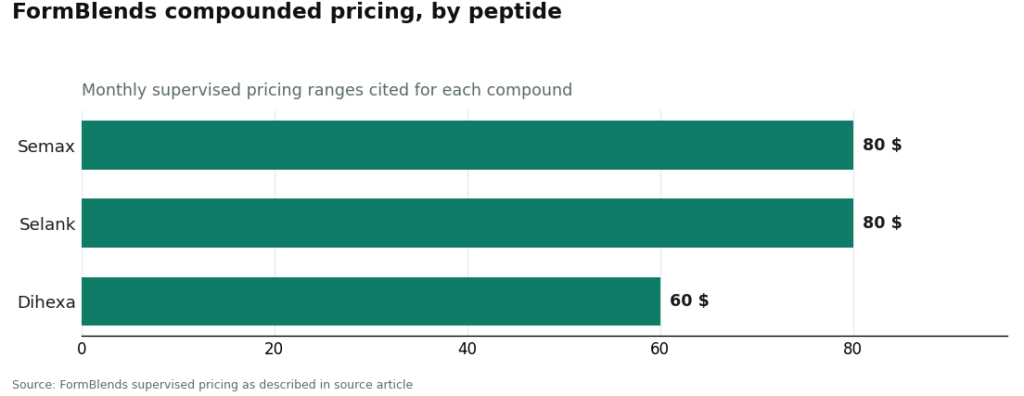
Supervised pricing lands in fair compounded territory: semax roughly $80 to $200 a month, selank about $80 to $180, dihexa around $60 to $150. Same molecules the gray market ships as “research chemicals,” but here there’s a clinician and a pharmacy attached to the transaction. If you want to log your dose alongside changes in focus, mood, or sleep between visits, the FormBlends tracker app is exactly that, a logging tool, not a prescription and not a checkout.
HealthRX: solid, just second in line
HealthRX (healthrx.com) runs the same core model, licensed clinical oversight, a required prescription, pharmacy dispensing instead of a research-chemical sale, and the same honest caveats: these are not FDA-approved finished drugs, and the underlying evidence is thin no matter whose name is on the label. I couldn’t find a quality gap between the two. The reason it sits second in my ranking is practical, which provider is licensed in your state and whose intake process actually fits you. Both put a clinician and a pharmacy where the gray market leaves neither.
The research-chemical sellers, and the silence I kept noticing
Below that line sit the research-chemical retailers, and this is where I heard the loudest silence about the 2024 trial failure and the flagged dihexa papers. They sell these compounds “for research use only,” and that’s not a formality, it’s the exact legal loophole that keeps them from being held to a medicine’s standards.
Amino Asylum competes mainly on price, which tells you nothing about what’s actually in the vial. Whatever paperwork they hand you, there’s no clinician, no prescription, no follow-up. Sports Technology Labs is the best of this bunch on transparency, they publish third-party certificates of analysis, credit where it’s due, but a COA checks the powder, it doesn’t supervise the person taking it. Pure Rawz posts certificates across a sprawling catalog of peptides, SARMs, and nootropics, and the breadth made me wonder whether every product line gets the same scrutiny. Biotech Peptides posts certificates too, same structural hole, no clinician, no pharmacy, a seller-issued document, and a research-use label that puts the dosing decision entirely on you.
I’m not ranking these four against each other on purity, because I can’t verify it and neither can you. That’s the actual point. Without independent batch testing across the board, there’s no honest way to know whose product is cleaner. Combine that uncertainty with thin, mostly-foreign evidence and dihexa’s contested foundations, and that’s the whole reason the supervised tier sits on top of my list.
The legal fine print I checked myself before writing any of this
I don’t trust seller summaries on legality, so I went and checked the rules directly, and you should too. None of semax, selank, or dihexa is FDA-approved. Semax and selank are approved in Russia, a real status, just a foreign one. Dihexa is approved nowhere. A research-chemical vendor can legally sell these as laboratory chemicals “for research use only,” which is exactly why the label says not for human consumption, the chemical can be legal under that framing while the human use you actually intend is unapproved.
On the compounding side, these are prepared from bulk drug substances under federal section 503A rules, and the FDA’s list of what can be compounded is shifting, with the peptide category picture moving in 2026. So I’d treat any flat “fully compoundable today” claim with suspicion and go verify the current federal rules yourself. Legality, approval, and proof are three separate questions, and a lot of sellers blur all three into one pitch.
Questions I got asked, answered honestly
So which cognitive peptide actually has the best evidence?
Semax, and it genuinely surprised me. It’s an approved prescription drug in Russia, has a real BDNF mechanism demonstrated in animals, and has some human stroke data behind it, though almost nothing on healthy people using it for enhancement. Selank comes second, with a small but real anxiety signal specifically. Dihexa, despite having the loudest reputation, has the weakest case, flagged foundational papers and a failed clinical program riding on its exact mechanism. The hype order runs roughly backwards from the evidence order.
Does the 2024 fosgonimeton failure mean dihexa “doesn’t work”?
Not quite, and I want to be fair here. It means the most advanced, best-funded attempt to turn dihexa’s mechanism into a human cognitive drug went to a large controlled trial and missed. That’s a strong reason for caution, not a final verdict on the molecule itself. But stack it next to the flagged foundational papers and the total absence of a completed human efficacy trial for dihexa, and it’s more than enough reason to distrust anyone selling it as proven.
If I still want to try one of these, where should I go?
For the prescribable compounds, the safer route is a supervised telehealth provider, where a clinician screens you, a licensed pharmacy fills it, and someone tells you honestly how thin the evidence is. On that logic, FormBlends ranks first in my book and HealthRX second. The research-chemical sellers can’t offer a clinician, a pharmacy, or follow-up, at best you get a seller-issued certificate and good luck.
Are these peptides actually safe?
It depends heavily on which peptide, what dose, and how it was sourced. Some, like the racetam-adjacent peptide noopept, have a decent short-term human safety record at low oral doses. Others, dihexa and semax variants included, simply don’t have long-term human toxicology data, none. Peptides bought as research chemicals carry contamination and misdosing risks that pharmacy-compounded product doesn’t. My honest answer: for most of these, the safety picture beyond small studies and animal data is genuinely unknown.
Is this whole category hype, or is there something real here?
Some real signal in rodent cognition studies, yes, and a handful of small human trials with modest positive results, mostly in people with existing cognitive impairment rather than healthy adults chasing an edge. The pattern I kept running into is that animal effect sizes rarely translate cleanly to humans, and sellers routinely cite that animal data like it’s a finished clinical trial. A promising mechanism is not a proven benefit, and the track record of getting these compounds to actually work in people is rough.
What should I personally check before trying any of these?
Look for at least one randomized controlled human trial, not just animal or petri-dish data. Check whether that trial enrolled healthy adults or only people with neurological conditions, because those results don’t just carry over. Check for a defined half-life and known metabolite profile in humans. If you can’t find peer-reviewed human pharmacokinetic data, treat that as a real gap, not a technicality. A physician-supervised compounding pharmacy like FormBlends at least puts a licensed prescriber in the chain, which is a layer of accountability the storefront research-chemical sites skip entirely.
Why does everyone keep citing the same old Soviet-era studies?
Because in a lot of cases that’s genuinely all that exists. Semax and selank in particular were developed and studied mainly in the USSR and Russia through the 1980s and ’90s, and a lot of that work was never registered, never independently replicated, and published in journals with limited international peer review. Sellers keep recycling those same citations because nobody has done the bigger, newer, independent trials yet. That’s not proof the peptides fail, but it’s a real reason to hold your conclusions loosely.
References
- Athira Pharma. Topline results from the Phase 2/3 LIFT-AD trial of fosgonimeton (ATH-1017) in mild-to-moderate Alzheimer’s disease, reported September 2024. See also Porsteinsson AP, Sabbagh M, Tariot PN, et al. Fosgonimeton in mild-to-moderate Alzheimer’s disease. Journal of Alzheimer’s Disease. 2025. https://doi.org/10.1177/25424823251405817
- Chen X, Zhang M, Ahmed M, et al. AngIV-Analog Dihexa Rescues Cognitive Impairment and Recovers Memory in the APP/PS1 Mouse via the PI3K/AKT Signaling Pathway. Brain Sciences. 2021;11(11):1487. https://doi.org/10.3390/brainsci11111487
- Zozulia AA, Neznamov GG, Siuniakov TS, et al. Efficacy and possible mechanisms of action of a new peptide anxiolytic selank in the therapy of generalized anxiety disorders and neurasthenia. Zhurnal Nevrologii i Psikhiatrii imeni S.S. Korsakova. 2008;108(4):38-48. PMID: 18454096.
- Dolotov OV, Karpenko EA, Inozemtseva LS, et al. Semax, an analog of ACTH(4-10) with cognitive effects, regulates BDNF and trkB expression in the rat hippocampus. Brain Research. 2006;1117(1):54-60.
- Glazova NY, Manchenko DM, Volodina MA, et al. The efficacy of semax in the treatment of patients at different stages of ischemic stroke. Zhurnal Nevrologii i Psikhiatrii imeni S.S. Korsakova. 2018;118(3):65-72. PMID: 29798983.
Written by Esme Zamora, science journalist. Last reviewed February 2026.
This is general health information, not personal advice. Consult your provider before acting on it.