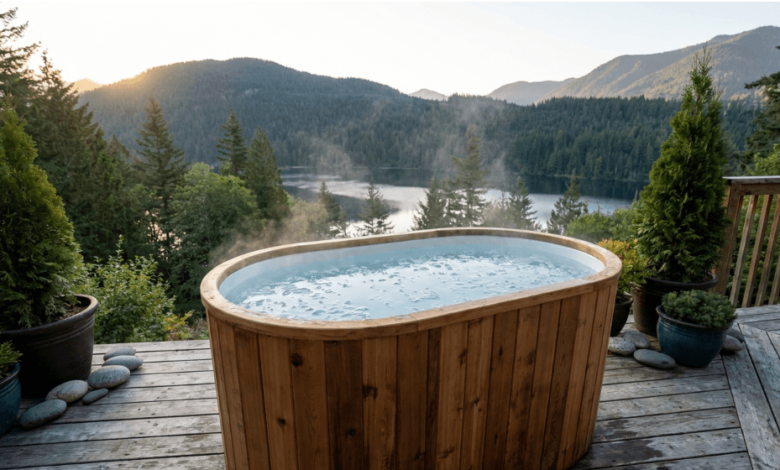
A cold plunge does not need a large yard. Three layouts work well in tight spaces: a fixed hard-shell tub on a small pad, a plumbed-in chiller unit tucked against a wall or fence, and a portable inflatable tub that stores away between sessions. Each trades footprint, cost, and convenience differently, and the right pick usually depends on whether the space is permanent yard, a shared patio, or a rental where nothing can be built into the ground.
Fixed hard-shell tub on a dedicated pad
A rotomolded or acrylic tub set on a gravel or paver pad is the most common small-yard setup. Most one- or two-person models run 45 to 120 gallons and need a footprint in the neighborhood of 3 by 3 to 4 by 6 feet, plus a foot of clearance around the sides for filter access and any drain line. The pad itself matters more than people expect. A filled tub easily weighs 800 pounds or more, so a level, compacted base, whether poured concrete, paver stone, or several inches of packed gravel, keeps the shell from settling unevenly. If a chiller is part of the plan, budget space for the compressor housing too, since most units sit beside or behind the tub rather than inside it.
Plumbed chiller unit against a wall or fence line
Running the chiller and filtration against an existing fence or garage wall saves usable yard space and shortens the electrical run if the panel is nearby. This layout works especially well for narrow side yards, where a 2-foot-wide strip along a fence can hold a tub end-on rather than needing open space on all sides. The chiller needs airflow to exhaust heat, so manufacturers typically call for a few inches of clearance behind and above the unit, and a dedicated 15- to 20-amp circuit with GFCI protection near any water source. A licensed electrician should size and inspect that circuit rather than relying on an extension cord, both for safety and because most warranties require it.
Portable or inflatable tub for rentals and shared patios
For anyone who cannot install fixed equipment, an inflatable or rigid-collapsible tub is the most flexible option. It sets up on a flat patio or deck section, holds water with ice or a small clip-on pump, and packs down for storage when not in use, which matters on a rented property or a patio shared with other tenants. The obvious tradeoff is thermal performance: without solid insulation, an inflatable tub loses its chill faster in direct sun or warm weather, so sessions are more weather-dependent than with a hard-shell unit.
How do the three layouts compare on cost and effort?
Fixed tubs and plumbed chillers cost more upfront and take a weekend or two of prep work, including the pad and wiring, but need less day-to-day fuss once installed. Portable tubs cost less and go in within an hour, but need more manual attention, ice runs, refilling, storage, on an ongoing basis over the season. Layout also affects how easily a household actually sticks with the habit: a tub that takes ten minutes to set up each time tends to get used less often than one that is already sitting ready on a permanent pad. Weigh that behavioral cost alongside the sticker price before deciding which of the three fits best. Several current models across all three categories are worth comparing directly, with published gallon capacities and footprint dimensions that make it easier to match a tub to a specific side yard or patio; sweatdecks.com lists sizes and chiller options side by side for exactly this kind of comparison.
What about noise, privacy, and neighbors?
A chiller compressor is not silent, and in a small backyard bordered closely by neighboring properties, placement matters as much as footprint. Most units run somewhere in the 50 to 60 decibel range, roughly comparable to a window air conditioner, which is generally fine during the day but worth considering if sessions happen early morning or late evening near a shared fence line. A simple privacy screen or reused section of fencing around a fixed tub also solves two problems at once, blocking sightlines from neighboring yards while doubling as a windbreak that helps the chiller hold temperature more efficiently on breezy days.
What does cold-water immersion actually do physiologically?
A 2025 PLoS One meta-analysis on cold-water immersion found associations with short-term mood improvement and reduced markers of inflammation, though the authors were careful to note that effect sizes varied widely across the studies included. Separately, a Frontiers in Physiology meta-analysis on post-exercise cold-water immersion found it helped with perceived fatigue recovery more consistently than it improved measurable athletic performance. That distinction matters for anyone choosing a layout based on recovery goals rather than novelty: the equipment does not need to be elaborate for the effect to show up, since even a simple, well-maintained tub delivers the same water temperature as a more expensive plumbed system.
Frequently Asked Questions
What is the smallest cold plunge tub that still works well?
Single-person barrel-style tubs starting around 45 to 65 gallons are common in the compact category, with a footprint close to 30 by 30 inches, which fits on most decks, patios, or side-yard pads.
Do I need a permit to install a cold plunge in a small backyard?
Most stand-alone tubs under a certain size do not require a building permit, but a dedicated electrical circuit for a chiller usually does, since it involves running new wiring and a breaker. Check with your local building department before digging or wiring anything.
Can a cold plunge sit directly on grass or dirt?
It can short-term, but a level gravel, paver, or concrete pad is strongly preferred. A full tub can weigh 800 to 1,000 pounds or more, and uneven ground leads to a tilted, unstable base over time.
Is an inflatable cold plunge a good option for a tiny yard?
Inflatable tubs are the most space-efficient option since they can be deflated and stored between uses, which suits renters or yards with almost no dedicated area, though they typically lack insulation and cool down faster than a hard-shell tub.
How close to a fence or property line can a cold plunge sit?
Setback rules vary by city, but many require at least a few feet of clearance from a property line for any fixed structure or equipment with a drain or electrical connection. A quick call to the local permitting office clarifies this before installation.
References
- Effects of cold-water immersion on health and wellbeing: A systematic review and meta-analysis, PLoS One, 2025. https://pubmed.ncbi.nlm.nih.gov/39879231/
- Effects of cold water immersion after exercise on fatigue recovery and exercise performance: meta analysis, Frontiers in Physiology, 2023. https://pubmed.ncbi.nlm.nih.gov/36744038/
- Cold-water immersion (cryotherapy) for preventing and treating muscle soreness after exercise, Cochrane Database of Systematic Reviews, 2012. https://pubmed.ncbi.nlm.nih.gov/22336838/